At a glance
- Format
- Walking across the desert over several days alongside pack camels, sleeping at a camp along the way
- Treks we list
- A 3-day camel trek (Erg El Mhazil) and a 4-day desert trek on foot with camels, on request
- Who we are
- A family business based in Foum Zguid
- Short camel ride
- Can be requested on our 4x4 tours to Erg Chigaga; confirmed in your quoteconfirmed when you plan
- Daily walking, support team, camp and group size
- Confirmed in your written quoteconfirmed when you plan
A camel trek and a camel ride are not the same thing
The words get mixed up in brochures, so it is worth being clear from the start.
A camel ride is short. You climb onto a camel at a camp or at the edge of the dunes, ride for a while, often towards a ridge for sunset or sunrise, and come back. It is a pleasant moment within a wider trip and needs no preparation beyond comfortable clothes. On our 4x4 tours to Erg Chigaga, a short ride can be requested; your quote confirms whether it is possible on your dates.
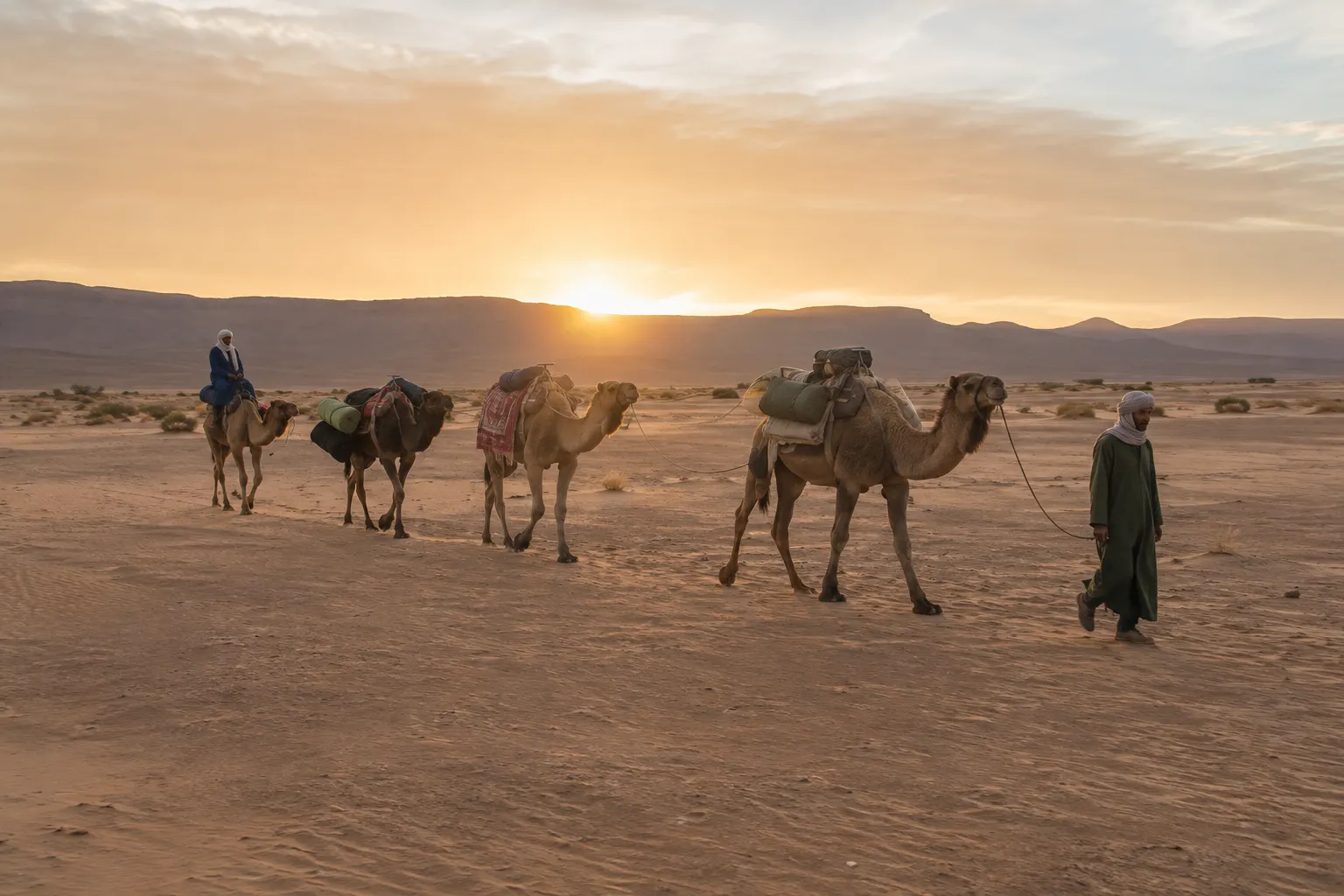
A camel trek is a journey. You walk across the desert for several days, with a small caravan of camels carrying the luggage, water, food and camp equipment. You walk most of the time, ride now and then if a camel is available for it, and stop each evening at a simple camp. The landscape changes slowly around you: stony plains, dry riverbeds, scattered acacias, low dunes, then deeper sand. You arrive somewhere because you walked there.
The two suit very different people. If you only want the feeling of riding through the dunes, a ride is enough. If you want time, silence and the rhythm of the desert, a trek is what you are looking for.
Who a camel trek suits
A trek is a good fit if you:
- enjoy walking and are comfortable on your feet for several hours a day, several days in a row;
- like simple living: eating outdoors, sleeping in a basic camp, going to bed early and waking with the light;
- want the desert itself to be the destination, rather than a backdrop to a comfortable night;
- are happy to let a guide set the pace and make decisions about heat, wind and the route.
It is probably not the right choice if you have limited mobility, dislike heat or cold, need reliable phone signal, or want private bathrooms and electricity every night. In that case, a private 4x4 trip with a night at a bivouac in the dunes gives you the landscape with more comfort and less effort.
Families can trek, but it depends very much on the children’s ages and stamina. For many, a desert trip with children works better in a shorter format, with a walk in the dunes and a short ride rather than days on foot.
How long should a trek be?
There is no single right answer, but a few principles help.
One or two nights is less a trek than a taste of one. You will walk, but much of the time goes on getting to the start and back. If you are short of time, a 4x4 trip to the dunes with a walk on foot is often the better use of it.
Three to four days is where trekking really begins. By the second day your body has adjusted, the camp routine feels familiar and you stop counting the hours. Among the trips listed by our family business are a 3-day camel trek in the Erg El Mhazil area and a 4-day desert trek on foot with camels. Both are arranged on request: we confirm the route, the stages and what is included in writing when you ask. For most first-time trekkers, a 3-day camel trek is a sensible starting point.
Longer treks, such as a 5-day desert trek, can be discussed on request. They need more planning, more supplies and a realistic look at the season. If that is what you have in mind, describe it in your enquiry and we will tell you honestly what is possible.
Whatever the length, remember to count the journey to the starting point. Coming from a big city means a long drive before the trek begins.
How a trekking day usually flows
Every route and every guide is different, but desert walking follows the sun, and most days have a similar shape.
You wake early, when the air is still cool. Breakfast is simple, the camp is packed and the camels are loaded, which takes a while and is worth watching. You walk through the morning, while the light is low and the sand still firm underfoot.
As the heat rises, the group stops in whatever shade can be found, under an acacia, beside a dune or under a tarp, and stays there through the hottest part of the day. Lunch is prepared, people doze, read or talk. This long pause is not lost time: it is what makes the rest of the day possible.
You set off again in the afternoon and stop before dark, leaving time to set up camp, wash a little and watch the light fade. Dinner is eaten together. Nights are quiet, very dark and, for much of the year, cold.
Your guide will adjust this rhythm to the season, the wind and how everyone is feeling.
The support team
A camel trek is never just you and the animals. Our trek formats are built around a small support team, typically a camel handler, who loads, leads and cares for the camels, and a cook, who prepares meals along the way. The exact team for your trek, who leads the walk and which languages they speak, is confirmed in your written quote.
The team knows where to find shade, how to read the weather and how to pace a group. Listen to them, especially about water, heat and where to put your feet. And remember that the camp you find each evening is someone’s work: a word of thanks goes a long way.
Camp styles on a trek
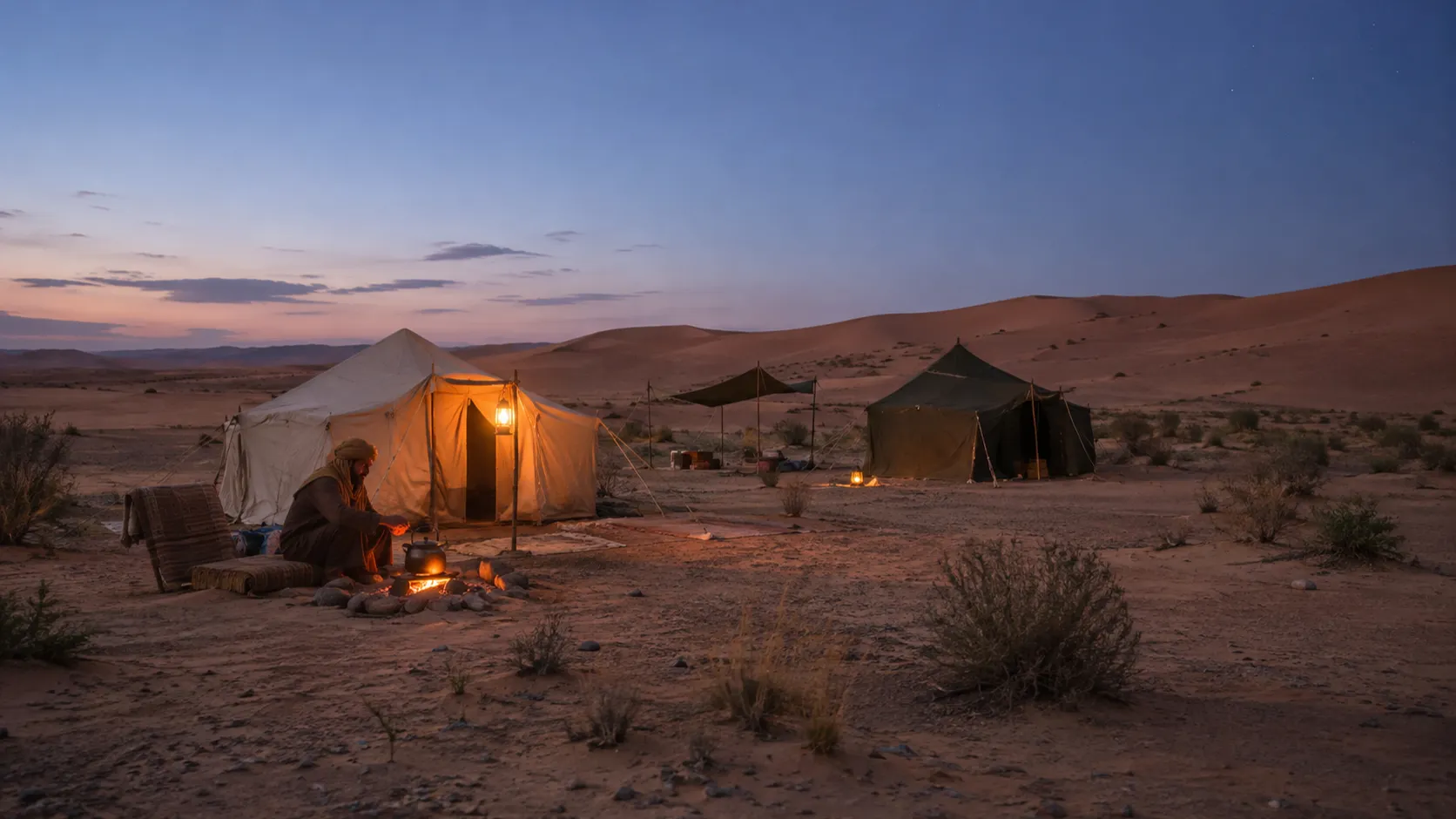
Treks almost always use a mobile camp: a simple bivouac carried by the camels and set up where the group stops. It may be different every night. Some treks finish at, or pass by, a fixed camp in the dunes, which has more facilities.
Because standards vary so much, ask specific questions rather than relying on words like “bivouac” or “camp”:
- Do you sleep in a tent, or under the stars with a tent available if it gets cold or windy?
- What do you sleep on: a mattress, a mat, blankets? Should you bring a sleeping bag?
- What is there for toilets and washing, and how much water is carried for washing?
- Is the camp moved every night, or do you return to the same place?
We answer all of these in writing before you book.
Camel welfare: what to look for
Camels are strong, patient animals, but they are working animals that need care. A responsible trek looks after them as carefully as it looks after you. Things to notice, and to ask about:
- Loads: camels should carry balanced, reasonable loads, with saddles that fit and padding to prevent sores.
- Rest and water: they should rest when the group rests, and be watered and fed properly.
- Health: an animal that is limping, injured or exhausted should not be ridden or loaded.
- Handling: a good camel handler is calm with the animals and never needs to be rough.
As a traveller, you help by not asking to ride for longer than the handler suggests, by mentioning your weight if you plan to ride, and by asking questions. How the camels on your trek are cared for is a fair thing to ask any organiser, including us.
Safety in the desert
A trek is not dangerous when it is well organised, but the desert is unforgiving of carelessness.
- Heat and sun: cover your head, wear sunglasses and sunscreen, and drink regularly, before you feel thirsty. The midday pause matters.
- Feet: blisters are the most common problem. Walk in shoes you already know, and deal with any hot spot as soon as you feel it.
- Riding: a camel stands up back legs first, then front. Hold on and lean back as it rises, forward as it kneels. Follow the handler’s instructions.
- Cold nights: from late autumn to early spring, nights can be genuinely cold. Bring warm layers.
- Wind and sand: a scarf or buff protects your face; keep cameras and phones in a sealed bag.
- Stay with the group: distances are deceptive and every dune looks alike. Don’t wander off alone, even near camp.
- Signal: don’t count on mobile phone coverage. Ask how the team communicates and what happens in an emergency.
Tell us in advance about any medical condition, allergy or medication, so the team knows and the right supplies are carried.
Preparing for your trek
A short, practical list:
- comfortable, broken-in walking shoes, plus sandals for camp;
- light, loose, long-sleeved clothing for the day and warm layers, a hat and socks for the night;
- a wide-brimmed hat, sunglasses, sunscreen and lip balm;
- a scarf or buff against sun and sand;
- a refillable water bottle;
- a head torch;
- a small personal first-aid kit, including blister plasters;
- wet wipes, hand sanitiser and a small towel;
- a bag to carry your rubbish back out of the desert;
- a soft bag rather than a hard suitcase, since luggage is loaded onto the camels. Ask about any weight limit.
Season matters. Autumn, winter and spring are generally the most comfortable for walking, with winter bringing cold nights. Summer heat makes trekking hard and is best avoided.
Planning a camel trek with us
We are a family business based in Foum Zguid. Every trip is arranged directly and privately for your group, and there is no instant booking.
Use our trip planner and tell us how many days you have, how many people are travelling (with children’s ages), your walking experience, where you are coming from and anything that matters to you, from food to sleeping arrangements. We reply with a written quote describing the route, the stages, the team, what is included and the terms. If a trek isn’t the right fit, we will say so and suggest something that is, such as our 3-day tour to Erg Chigaga, which leaves time for long walks in the dunes.
Questions travellers ask
Do I need to be very fit to go camel trekking?
You need to be comfortable walking for several hours a day, on sand and stony ground, for several days in a row. It is not technical and you set a steady pace with plenty of rests, but it is more tiring than it looks: soft sand, sun and wind add up. If you walk regularly at home, you will usually manage well. Tell us about any health condition or injury before you book.
Will I ride the camel the whole way?
No. On a trek the camels mainly carry the luggage, water, food and camp equipment, and you walk beside them. Riding for part of the way is often possible, for instance if you are tired or have a sore foot, but whether there is a camel available to ride and for how long is something to confirm in your quote rather than assume.
How far do you walk each day?
It depends on the route, the season, the heat and the group, so we don't publish a fixed figure. Your guide adapts each day to conditions and to how everyone is feeling. When we prepare your trek, we describe the stages and the expected effort in writing.
Is there a toilet or a shower on a camel trek?
Treks use simple, mobile camps, so don't expect the facilities of a hotel or a fixed camp. What is provided for toilets, washing and water is confirmed in your written quote. Many trekkers bring wet wipes, hand sanitiser and a small towel.
Can children go on a camel trek?
It depends on their age, their stamina and how much they enjoy walking. For many families, a shorter format works better: a 4x4 trip to the dunes with a night at the bivouac and, on request, a short camel ride. Tell us the children's ages and we will suggest something realistic.
Can I combine a trek with Lake Iriki and the Erg Chigaga dunes?
Ask us. Our 4x4 tours cross the Iriki basin to the Erg Chigaga dunes, and treks can be discussed on request. Describe how many days you have and what you most want to see, and we will tell you honestly what can be combined.
Is camel trekking ethical?
It can be, when the animals are well cared for, properly loaded, watered and rested, and not ridden when injured or exhausted. Ask any organiser, including us, how the camels are looked after. A good handler is glad to answer.
Sources
Facts on this page were checked against the sources below. Conditions in the desert change — ask us for a current report before you travel.
First published ·Last updated